

Living Culture at Lesedi Cultural Village
One of my goals for this journey has been to better understand the diverse cultures that shape South Africa and Africa more broadly. While museums have provided invaluable historical context, our visit to Lesedi Cultural Village offered something different: an opportunity to experience the cultures as something alive.

The tour introduced us to five of South Africa’s cultural groups—the Pedi, Basotho, Xhosa, Ndebele, and Zulu. As we moved through each traditional homestead, we learned about their distinctive architecture, clothing, languages, customs, and ways of preparing food. It was a reminder that South Africa is not defined by a single culture but by many, each with its own identity and traditions.

One thing I thought was funny though, was how at each stop there was a clear focus on the importance of cattle as the pen was almost always in the center of each village for protection. The theme continued with an explanation of how many cattle were required to purchase a wife in each culture. I have to go back and check but I think Zulu required the most at 23 cows for a wife. I’ll have to research more later when I get back.

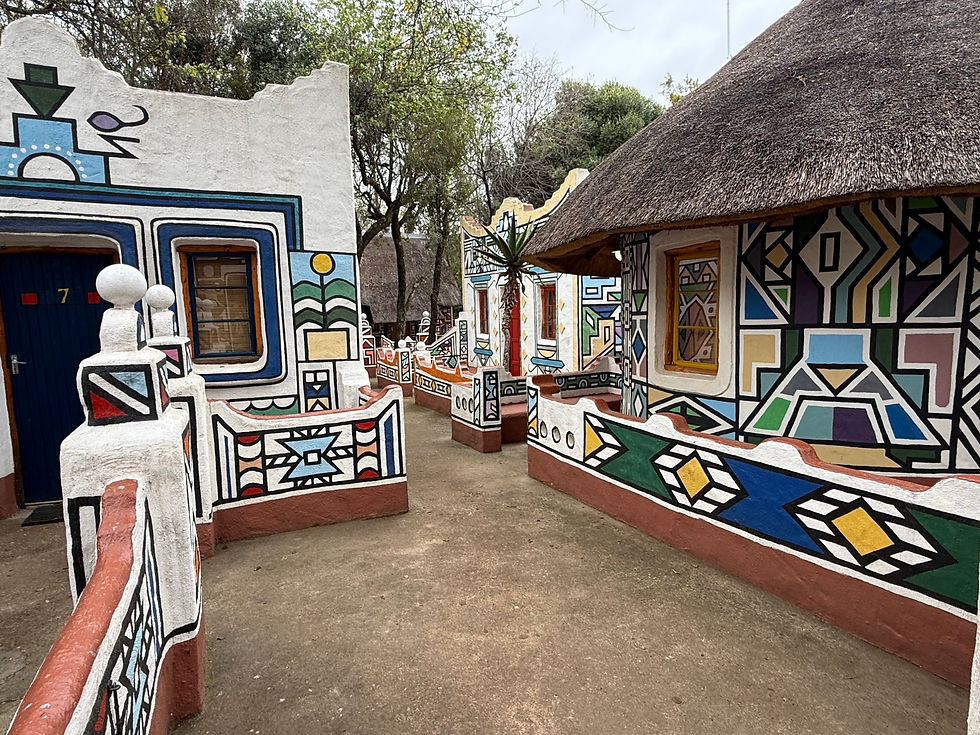
One of my favorite aspects of the visit was seeing how architecture reflects culture. Although many of the homes share common building materials, each community has developed its own forms, decorative patterns, and spatial organization. As an art teacher, I found myself paying close attention to the relationship between function and the form needed for each area.


Of course, no cultural experience is complete without trying the food. I decided to be adventurous and sampled a dried caterpillar—a traditional source of protein in many parts of southern Africa. The verdict? Surprisingly edible. The closest comparison I could come up with was a stale, salty cheese puff. Not exactly something I’ll be craving back home, but I’m glad I gave it a try!

We had to ask permission from a guard to high on a wall and armed with a spear to enter the Zulu village. There we met several members of the village as our guide explained the meaning of the women’s fashion. The beaded apron of the young women was meant to indicate that she was available for marriage. The headdress of the married woman was particularly interesting. It is always red and has a special shape. They were woven into their hair so they could not be easily removed. This also explained why the Zulu used a wooden headrest for sleeping. This allowed them to keep this on their head at night while sleeping. I’m not convinced how comfortable that system is but it is an interesting cultural factor that we would learn even more about later in Durban.


We also got to meet some Zulu warriors who where hanging out around a fire underneath a huge elephant skull. Very dramatic. Our guide explained their weapons and the warriors show how they were used by pretending to stab me confirming that I wouldn’t last a day in the bush.


The highlight of the day, however, was the music and dance.
Each community shared traditional welcome songs which made the experience seem even more authentic. The end of the tour featured a a performance in the “boma” accompanied by energetic drumming and dancing with an explanation of which cultures the dance came from as well as the meaning of each dance. The athleticism of the dancers was extraordinary, with rhythmic footwork, powerful jumps, and movements performed with incredible precision and joy. Watching the performances, it became clear that dance is far more than entertainment. In one Zulu dance in particular the dancers kick their leg incredibly high, almost into their chest! They do this repeatedly until they fall down backwards on the ground. This is meant to demonstrate a soldier falling in battle.


Throughout this trip I’ve been looking a t art old and new, but experiences like this have expanded my understanding of what “art” really means. It isn’t limited to paintings or sculpture. It lives equally in architecture, textiles, music, dance, storytelling, and the rituals of everyday life.
As a teacher, these are the experiences I hope to bring back to my classroom. It’s one thing to show students photographs of traditional homes or ceremonial dress. It’s another to describe hearing the songs, feeling the rhythm of the drums, and watching the dancers move.
Oh and eating a caterpillar and almost getting stabbed by a Zulu warrior!
Thanks for following along.


Comments