

Beading workshop at NETSHOMI ZAM
I had my a special beading workshop in the Woodstock area of Cape Town with Riann and Nick from Netshomi ZAM. While their focus is on a contemporary commercial market, the experience had many eye opening lessons about
They specialize in the creation of beaded animal sculptures and baskets for the tourist trade

The craft of beading and the tremendous skill of these practitioners was evident. Working with Nick, he would show me what appeared to be a simple maneuver, but like many forms of art, it was much harder than it looked. The idea of finesse was apparent when we failed repeatedly at doing a simple task.

One of the most fun and surprising tricks was how to add the beads to the wire. You would slightly bend the wire and then after pouring beads into a modified bowl on a spindle, you spin the bowl and “gently skim” the surface of the spinning beads. Just like magic the beads would feed up the wire. It was like magic! I still can’t quite believe that it works but it certainly is a more efficient way of stringing beads than doing it one by one. Watch the video to see this in action.
While this works great if you have a solid color, it doesn’t work when you have a specific pattern like the Ndebele designs on some of their beaded baskets. These require you to add the beads by hand in a very precise order.

All beadwork has some form of armature. This is the strong wire underpinning that the beadwork is attached to. For the animal sculpture they use a MiG welder to link the heavy wire together. For our simpler projects, we used needle nose pliers to bend the slightly strong wire into the desired shape of a star and a heart. Again, this looked deceptively simple and was much more challenging when we had to do it ourselves.

Now with our armatures ready we loaded our bead onto the wire and began to wrap. But first we had to attach the beading wire to the armature. Nick had the “magic twirl” where he would quickly loop it around and the twirl the wire into such way it would break off flush to the armature. He preferred this method to cutting it with wire cutters because it did not leave a sharp point. I was only able to do this once the whole time. Again, finesse!
The process of adding the beads was pretty straight forward, add a row, flip, then repeat. The challenge was to keep the rows straight on each side. Oh and finishing with the magic twist. The star was the beginner shape because it was easier with straight sides. The heart with its curved sides was more complicated because the rows of beads would slip on the curves so you had to tie it off every few rows. Then when you got to the top two curves you had to start again and carefully fill in the tops.
It was quite fun and satisfying even if our rows were not very straight. However in Nick’s magic hands he was able to help straighten them out.

Nick was very patient and kind with us. I asked him where he had learned this skill. He said he was originally from Zimbabwe and a friend had shown him the basics. He has been working in this craft full time for the past fifteen years ever since.
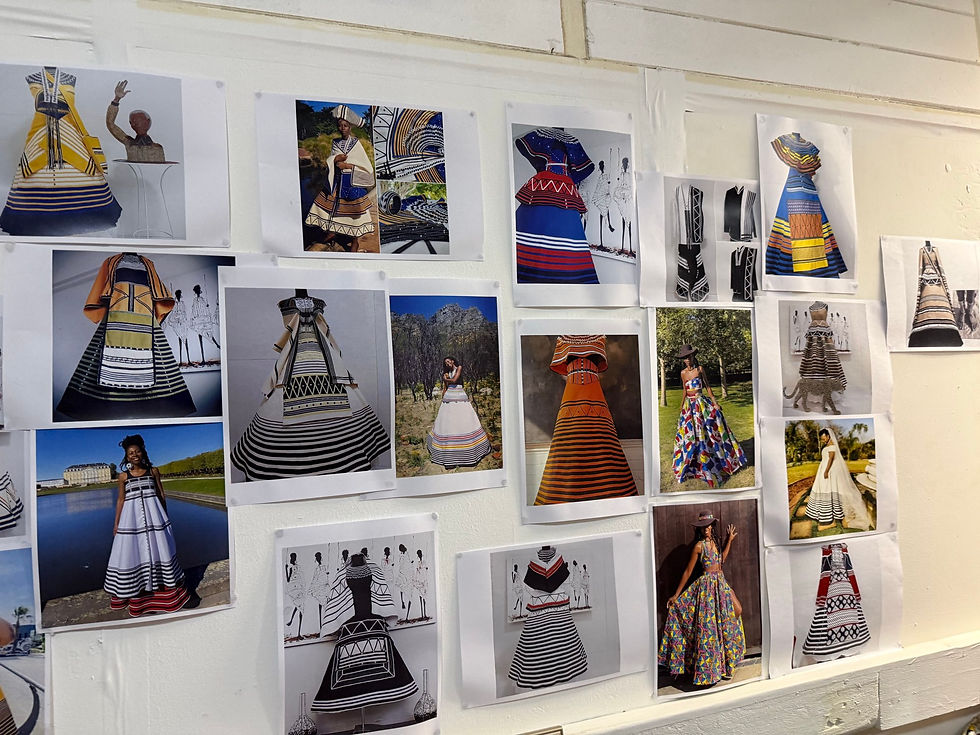
A bonus surprise was that there was a Xhosa dress designer and maker that shared the studio space. She kindly paused her work and showed me several of her designs. They are used for specific Xhosa ceremonies where a sacrificial goat is to be slaughtered, like weddings, when the mother and bride have to wear specific types of traditional clothing and specific colors. I asked where she learned to do this and she said she just grew up doing it as a part of her culture. Now she and her assistant work to create the clothing. She makes the dresses while her colleague does all the traditional hand embroidery and beadwork on the dresses.
The three hour workshop went fast but ideas for workshops with my students and fellow teachers were already percolating! I’m excited to get home and share these new skills with the Maggie L Walker community.


Comments