

Back Seat Politics
Updated: Jul 16

Although this journey was built around art, it quickly became apparent that politics is never very far from the conversation. I was honestly not surprised. Art acts as a mirror to the society that produces it, and after nearly a month in South Africa I found that understanding the country’s contemporary artists also meant trying to understand the political realities shaping their work. This is a concept that I teach to my students at Maggie L. Walker Governor’s School.

Contemporary South African artists are not simply documenting issues within the country—they are participating in democracy itself. While on the trip, I purchased the catalogue for a recent exhibit that we unfortunately missed at the Norval Foundation, We, the People: 30 Years of Democracy in South Africa. The exhibition begins with a premise: democracy is not something a nation simply possesses—it is something people continually create through participation and debate. Rather than celebrating thirty years of freedom as a finished achievement, the exhibition asks viewers to wrestle with what has been accomplished, what promises remain unfulfilled, and what kind of future South Africans still hope to build.

One artist from this catalogue that stood out is Igshaan Adams. Born in Cape Town during apartheid and a descendent of the Nama people, Adams creates intricate installations from traditional materials like rope, beads, wire, and textiles that speak to identity, belonging, and the invisible boundaries that continue to shape South African life. Adams also collaborates with women refugees and migrants living in Cape Town through the Scalabrini Centre’s Women’s Platform, incorporating traditional weaving and beadwork into a practice that provides both artistic collaboration and economic opportunity. That partnership felt especially relevant after hearing so many conversations about immigration during our travels. More on that later.
Beyond the art, much of our political education happened in the back seat of Ubers.
My wife Colleen has a gift for asking thoughtful questions, and nearly every driver became an informal political analyst. We would ask about daily life, elections, and the economy. While no two conversations were identical, certain themes surfaced again and again.
The first was political corruption.
They were not upset with the corruption. Instead, there was a kind of weary acceptance. Driver after driver described corruption almost as a fact of life. Many spoke about politicians enriching themselves while basic services lagged behind. We heard stories about unreliable infrastructure, police stopping drivers looking for bribes, and communities that still lack adequate housing, water, or sanitation more than thirty years after the end of apartheid.
Those conversations matched much of what we saw ourselves with sprawling townships in the cities next to posh neighborhoods or rural villages without sewer infrastructure and folks carrying jugs of water for daily use.

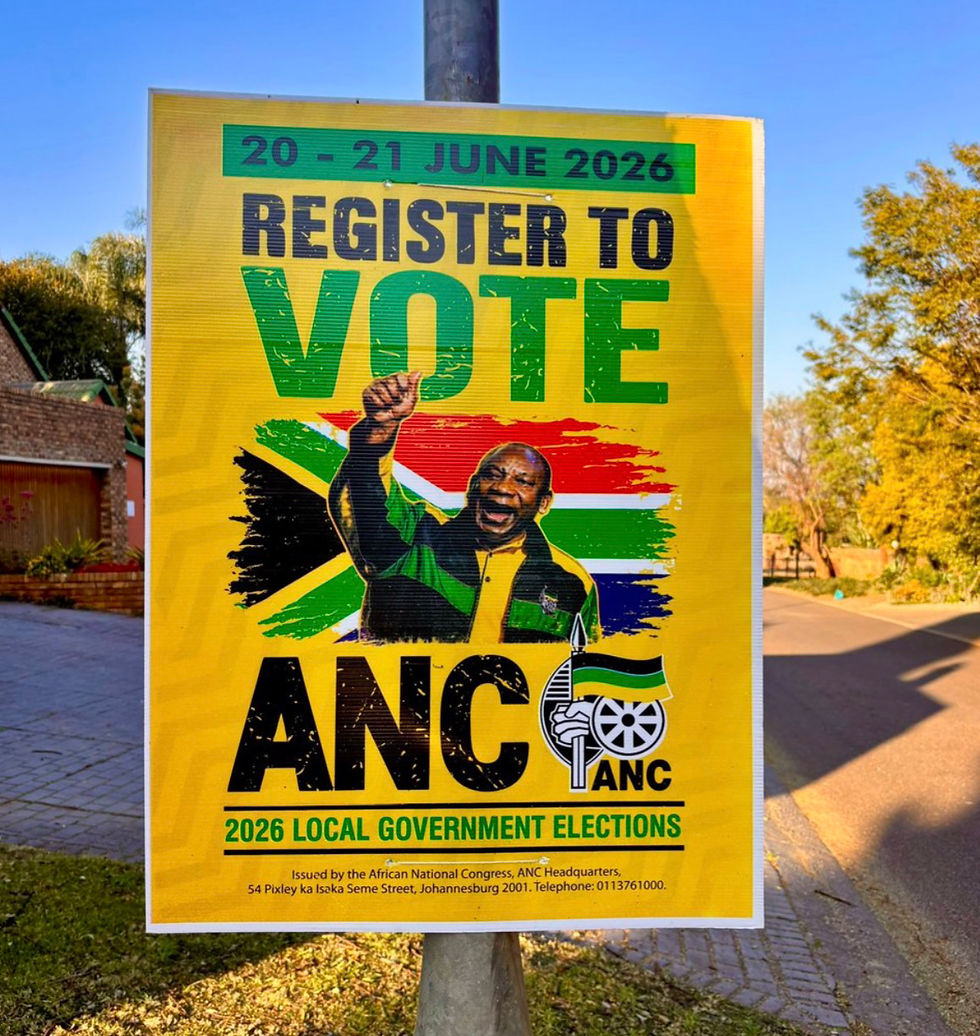
South Africa’s political landscape has changed dramatically. For three decades after apartheid, Nelson Mandela’s African National Congress (ANC) dominated national politics. But growing frustration over corruption, unemployment, electricity shortages, crime, and public services led to a historic shift in the 2024 election, when the ANC lost its parliamentary majority for the first time and entered coalition government.

At the same time, several younger South Africans told us they no longer believed voting could produce meaningful change. Their comments echoed broader research showing declining voter participation and growing dissatisfaction with political institutions, particularly among younger voters frustrated by unemployment, corruption, and slow progress. It was sad to hear.
Another topic that surfaced almost as frequently: immigration. Nearly every conversation eventually turned there.
Many people we spoke with expressed concern that undocumented immigration was increasing competition for jobs during a period of exceptionally high unemployment (between 30% and 40% unemployment). Others distinguished between migrants fleeing hardship in neighboring Zimbabwe or instability in Mozambique and criminal organizations they associated with trafficking and organized crime mainly from Nigerian immigrants. These were the opinions we heard repeatedly, though not everyone agreed.

One woman working at a guesthouse offered a different perspective. She acknowledged the economic pressures but emphasized that many immigrants were simply trying to build better lives for their families. Though this opinion was definitely in the minority.
Listening to these conversations, I was struck by how familiar it sounded. It echoed much of the debate about immigration that we have had in the United States over many years.
Economic insecurity. Housing. Immigration. Distrust of political leaders. Rising gas prices. Questions about who belongs. These were remarkably similar conversations to those happening at home.
On this same topic, one of the most surprising encounters came on my flight home. Sitting beside me was a retired South African teacher preparing to immigrate to the United States. We chatted—not about politics at first, but about education. Eventually our conversation turned toward why she had decided to leave her life in South Africa. She said she did not feel there was a future for her as a white person in South Africa. I was sad to hear that but did not question her perspective.
Earlier on this journey, I wrote about Ubuntu—the South African philosophy that our humanity is bound together through the humanity of others. What I also learned is that ideals like the idea of a rainbow nation and challenging realities often exist side by side.
I was saddened by the unfinished promises of the South Africa that Mandela had envisioned. However, the contemporary artists are challenging us to look and listen more carefully and to recognize that the story of post-apartheid South Africa is neither one of failure nor complete success, but an unfinished conversation. I am hopeful in the fact that the artists are part of that conversation.


Comments