

My visit to Zeitz MOCAA
One of the primary goals of this trip is to better understand the artistic traditions of Africa. While much of that exploration has focused on indigenous art forms, I am equally interested in how contemporary African artists draw upon, transform, or challenge those traditions. There was no better place to begin that investigation than Zeitz MOCAA, Cape Town’s Museum of Contemporary Art Africa.
Before even entering the galleries, the museum itself demands attention. Housed in a dramatically renovated grain silo on Cape Town’s waterfront, the building is one of the most remarkable examples of adaptive reuse I have encountered. Architects transformed the former industrial structure by carving away the negative space of a giant corn kernel from the interior silos, creating a soaring atrium of curved concrete forms. The result is both monumental and surprisingly elegant, connecting Cape Town’s industrial history to its contemporary cultural ambitions.

Suspended within this dramatic space was The Procession (2025), a site-specific installation by Ghanaian-American artist Rita Mawuena Benissan. Drawing on the colorful processions and royal traditions of Ghana, Benissan transformed textile traditions into an enormous sculptural tapestry that fills the atrium. The work immediately demonstrated one of the themes I hoped to explore on this trip: contemporary artists often innovate in scale, materials, and presentation while remaining deeply connected to their cultural roots.
During our visit we explored three exhibitions: Sala, drawn from the museum’s permanent collection; Afflict the Comfortable, Comfort the Afflicted by African-American artist Cauleen Smith; and We Proceed in the Footsteps of the Sunlight by Ghanaian-German artist Zohra Opoku.

The exhibition that resonated most strongly with me was Sala. The title comes from a Nguni expression meaning “stay well,” and the exhibition invites visitors to slow down and reconsider what a museum can be and who it serves. Organized around themes such as identity, labor, memory, and belonging, the exhibition asks visitors to think critically about how art shapes the way we see ourselves and others.
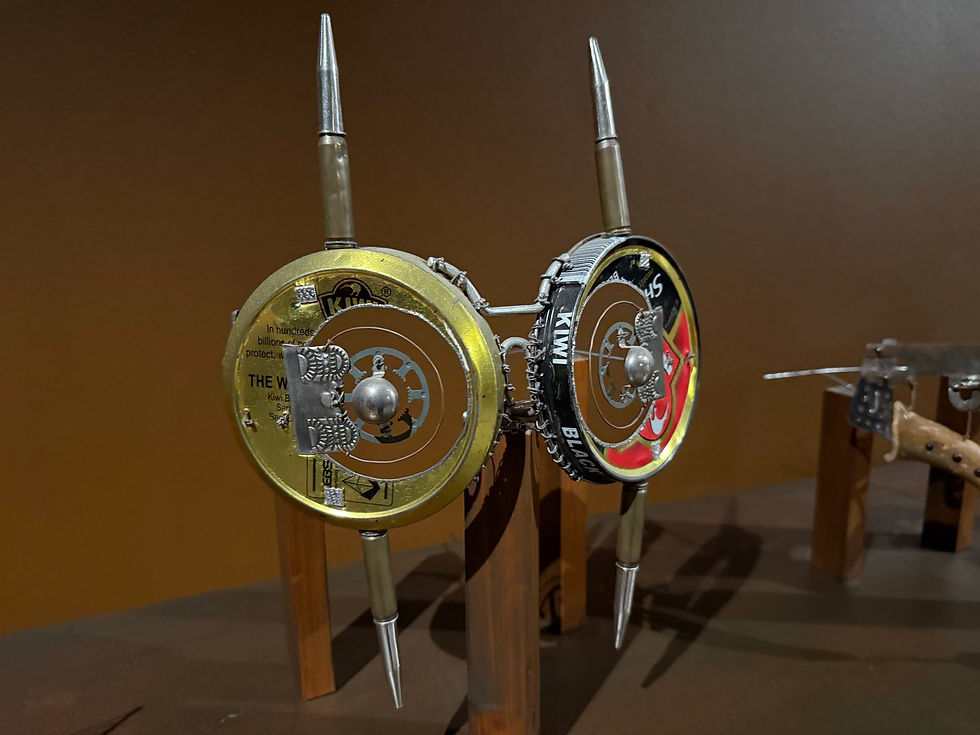
Several works stood out. Cyrus Kabiru’s C-Stunners—elaborate eyewear sculptures assembled from discarded materials—were both playful and thought provoking. Originally denied a pair of glasses as a child, Kabiru began making his own. The resulting works reminded me of traditional African mask-making and sculpture, transforming found objects into imaginative tools for seeing the world differently. Michele Mathison’s installation Chibage similarly challenged viewers to consider labor, value, and who benefits from systems of production.


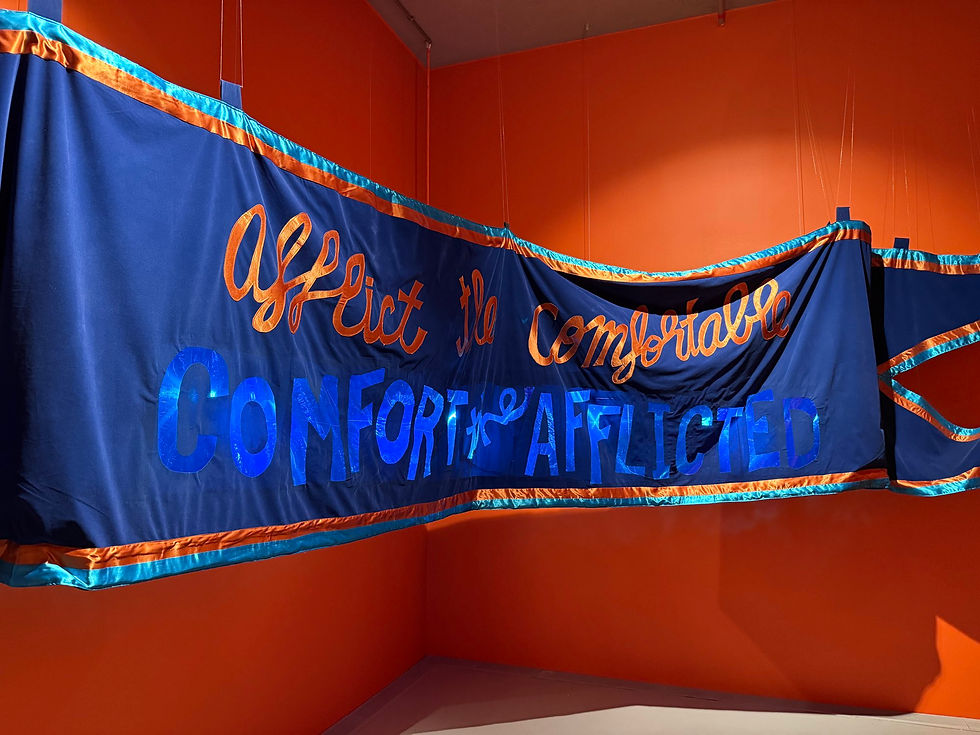
I was initially surprised that one of the museum’s major exhibitions featured an American artist rather than an African one. However, Cauleen Smith’s exhibition, Afflict the Comfortable , Comfort the Afflicted, highlighted the museum’s commitment to artists throughout the African diaspora. Working across film, textiles, installation, and text, Smith addresses themes of Black identity, community, and resilience. Her colorful banners and multimedia installations were visually engaging while tackling difficult histories. One particularly memorable video work reflected on the erasure of Black communities in the American South, reminding visitors that struggles over memory and power extend far beyond national borders.


The exhibition by Zohra Opoku offered perhaps the strongest connection to my interest in contemporary applications of traditional materials. Born to a Ghanaian father and German mother, Opoku uses photography, textiles, printmaking, embroidery, and video to explore questions of heritage, belonging, and self-representation. Her work often centers on clothing and veiling, examining what identity reveals and what it conceals. I was especially interested in how her practice combines contemporary photography and installation with traditional textile techniques such as embroidery and beading. In many ways, her work embodies the central question of this trip: how artists honor cultural traditions while creating something distinctly contemporary.


After more than four hours in the museum, I left with far more questions than answers—and that’s usually a sign of a successful museum visit. Zeitz MOCAA demonstrated that contemporary African art is not a single movement or style. Instead, it is a rich and complex conversation involving history, identity, migration, memory, and cultural inheritance. While the forms may be contemporary, many of the ideas remain deeply connected to traditions that stretch back generations.
For someone hoping to understand both the past and future of African art, it was an inspiring place to spend the day.


Comments